This piece is part of a cross post on Stardew Valley that I am doing with my brother Austin Jantzi. Our writing is a little different in style, but we both write about our love of Stardew Valley and its focus on the small, day to day activities of life. If you like our work then subscribe and share it with a friend!
We are living in a time where generative AI appears to be doing more and more tasks that were once assumed to be beyond the capabilities of a machine. It is forcing many people to ask the question: what does it mean to be human? Wendell Berry has spent a lifetime answering that question. Paul Kingsnorth summarizes Berry’s answer like this: “Slow down. Pay attention. Do good work. Love your neighbors. Love your place. Stay in your place. Settle for less, enjoy it more.”1 While it seems simple at the surface level, Berry has written millions of words in his novels, essays, short stories, and poetry that get to the root of what that kind of life should look like. In short, it looks radically different from the way most of us live. When I read Berry, I often struggle to comprehend how to apply it to my own life. If I want to follow his example, then I should move to a farm, start raising food for my family, and get rid of most of the technology that I take for granted. How can I live more like Berry without a complete life change? The answer starts in what seems like a surprising place: the video game Stardew Valley.
Yes, I am recommending a video game to help understand the writing and philosophy of a man who famously does not own a computer. I am sure that Wendell Berry himself would not recommend it. But Berry lives in a different world than we do. Not physically, but his daily life and patterns of thought inhabit a world few of us would recognize. His work of farming and writing looks much the same as it did 50 years ago. He uses mules and horses as much as he can. He writes longhand with a pencil in a cabin he built himself. The physical place where he has spent his life, a farm near Port Royal, Kentucky, is as much a companion to him as all the people he has known and loved there over his long life.
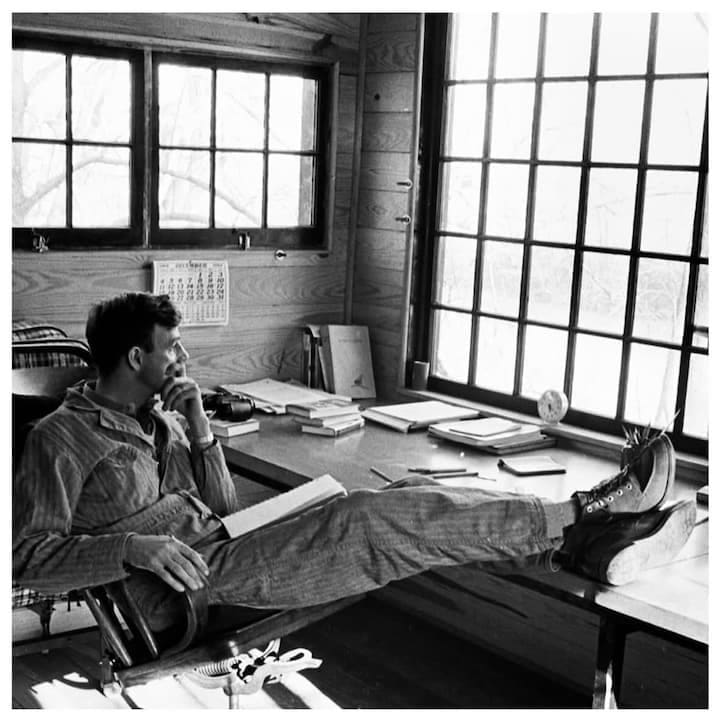
To understand Berry, you must go to a different world. You can do that through his books. His novels and short stories of the people of Port William are an alternate reality which mirrors Berry’s life in Port Royal. Many of the characters are modeled after Berry’s family and friends, including Berry himself. But to truly understand Berry’s world, you have to experience it for yourself. If only I could inherit a farm in the country and go live there for a while…
That is, of course, the setup to the game Stardew Valley. The player is working a dead-end office job. You remember your grandfather’s offer of a “change” and find he’s given you the deed to a farm in Stardew Valley. You start with a cabin, some basic hand tools, and 20 parsnip seeds. It’s up to you to figure out how to live in this new world: how to farm, how to get to know the place, how to become a member of the community.
These are also the things that Berry would teach us. Yet they can be learned in some small way through playing Stardew Valley. In the same way that children learn to work and resolve conflict through play, we can learn to live in Wendell Berry’s world through a game. No, Stardew Valley does not have the depth required to teach you how to actually plant a garden or develop deep relationships with your neighbors. But we don’t expect children’s games to do so either. These games, and their imperfect representations of the world, point us toward the true and good things that underlie them.
One of these true things is the need for place. Berry’s place is the town of Port Royal and its surrounding farms, ridges, fields, woods, creeks, and the Kentucky River. He knows this place more fully than anyone else does, in a way that few of us know our places, if we even know them at all.
This knowledge is not limited to the physical geography of the land. It’s about how the land interacts with nature: the seasons, the weather, the plants and animals. It’s about how the land changes over time. Part of this is because he’s a farmer. For a farmer, things like the weather, seasons, and the specific soil of a particular field matter a lot. My dad is obsessed with the weather, especially the dew point, and I have to imagine it’s a remnant of his time growing up on a farm. I don’t share that obsession. My day-to-day is much the same in rain or shine, summer or winter.
But it’s not just about being a farmer. Berry writes eloquently in his prose and poetry about the small details of his place: the rising and falling of the water in the river, a falling leaf, a sycamore tree, a songbird, the way the creek sounds as you walk along it. This excerpt of a poem he wrote on a rainy day made me laugh but also shows just how well he knows the trees and animals:
The bare twigs of the elms
are beaded with bright drops
that grow slowly heavy
and fall, bigger
and slower than the raindrops.
A fox squirrel comes
through the trees, hurrying
someplace, but it seems
to be raining everywhere,
and he submits to wetness
and sits still, miserable
maybe, for an hour.2
Part of getting to know a place is the act of exploring it, of walking familiar paths and noticing something you didn’t before. Video games are the best medium for this kind of learning, and it’s an aspect that Stardew Valley excels at. The Valley is modeled after its creator Eric Barone’s experience growing up in the Pacific Northwest. There are mountains, woods, a river, a town, and the ocean. It takes time to explore and get to know the Valley in each of the seasons. Where to forage for roots or berries, and what to look for in each season. The best spots to fish, and what fish you can catch in the mountains that you can’t find in other places. How to get from your farm to the local library. It’s still just a game. Its world is not large or deep, but it teaches you how to explore and how to notice how things change with the seasons. Lessons that, when translated to your own physical place, help you to know it in a new, deeper way.
The people who live in a place shape it just as much as the forces of nature do. When humans make a place their home, a community is formed among those who live there. Hopefully, those that are part of that community depend on one another, help one another, and grow to know one another. Berry calls this type of community a “membership,” and it is the focus of his fictional stories in Port William. As you read them, you also become part of the fictional version of that membership, at least in some small way. You can learn to know the people of Port William—Jayber Crow, Wheeler Catlett, Burley Coulter, the Proudfoots—as they see each other and see themselves. You can see them work together, an act of mutual exchange. They help those that need it, knowing they themselves will need it in return. They are born, are married, have children, and die as part of the membership. You can leave the membership, as Berry did for a time, but you’re always welcome back if you return to it. Being included isn’t just about long-time connections to a place or being part of a specific family. In the novel Hannah Coulter, the title character marries into a Port William family and is forced to live with her in-laws while her new husband fights in World War II. She describes becoming a part of the membership in this way:
I was making myself at home. In the dark way of the world I had come to what would be my life’s place, though I could not yet know the life I would live in it.
I had come unknowing into what Burley would have called the “membership” of my life. I was becoming a member of Port William.3
For me, the core of Stardew Valley is also about membership. There is the obvious goal in the game of repairing the broken-down community center, a visible metaphor for a community that has seen better days. But it’s really in the everyday interactions that Stardew shows us how to become a member in your own community. It’s in the short conversations that happen as you walk around town or meet someone in Pierre’s store. It’s gathering in the Stardrop Saloon on a Friday night. It’s in the seasonal festivals and events, where traditions are built and maintained.
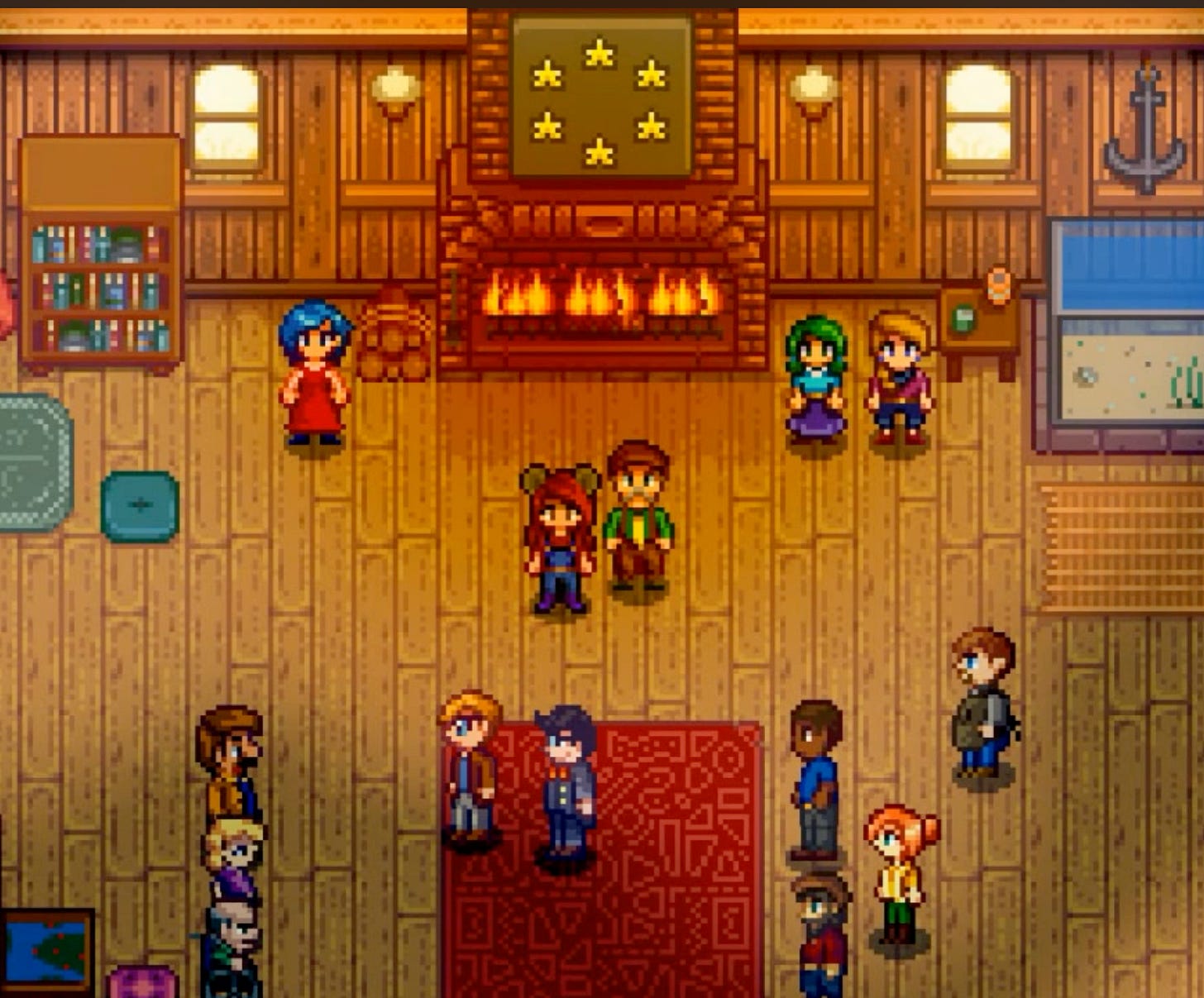
In the same way you get to know the residents of Port William, you learn the stories of the residents of the Valley. There’s Shane, the alcoholic who needs a reason to keep going in life. Clint, the town blacksmith, who’s in love with the local bartender, Emily, but can’t bring himself to say it. The stories are clichéd and shallow, but the point is that you have to learn the stories over weeks and years of small interactions. Those are what lead to deeper conversations and relationships. Many of us need to learn how to do that, and Stardew can help us play at it before we do it.
I recognize the irony in suggesting that you should learn to know your neighborhood and the people who live there by playing a video game, a game that simulates these things and can be used as a crutch. But I need a crutch, and many others do, too. My muscles for building community and paying attention to the place where I live have atrophied. I lurk in online “communities” and know what’s happening in Washington, D.C. I don’t know the names of most of the people on my block or the owner of my local coffee shop. I don’t know the names of the streets. Shifting my focus to my town and the people who live there is hard compared to just staying online, but I need to do it. I need to live more like a human and less like a machine.
Stardew Valley has helped me do that. I have learned by playing to look for and identify different kinds of trees as I walk around town. I have learned that crocuses are real and that they do come up in the winter in my real lawn, just like in the game. I have learned to know and help my neighbors and ask for help from them. Last year, an oak tree that was over 100 years old fell into my backyard. I did not yet own a chainsaw, so I started clearing some branches with a small handsaw. My 70-year-old neighbor took pity on me and brought his chainsaw and offered to help. I refused, but he insisted. We worked together to cut up a few logs. I helped carry and stack the pieces on his woodpile, which heated his home this winter. I’ve talked to him more since and learned about his life: how he bought the wood stove in the first place because of another large tree that fell in his backyard.
Though it only skims the surface, Stardew allows you to experience what it’s like to learn to know a place and become a member of the community. Like a child, I have learned through play. But now I’m an adult, and I must go beyond playing. I now spend time each day in the woods near my house, as Berry does. He has taught me to go deeper than the surface level of Stardew Valley. This passage from his essay describes the feeling of discovery in a way that a game never could:
One early morning last spring, I came and found the woods floor strewn with bluebells. In the cool sunlight and the lacy shadows of the spring woods the blueness of those flowers, their elegant shape, their delicate fresh scent kept me standing and looking. I found a delight in them that I cannot describe and that I will never forget. Though I had been familiar for years with most of the spring woods flowers, I had never seen these and had not known they were here. Looking at them, I felt a strange loss and sorry that I had never seen them before. But I was also exultant that I saw them now—that they were here.4
I take comfort in the fact that Berry also had to learn these things. When he returned to Port Royal after living in New York City, he had to learn to know it again:
I walked over it, looking, listening, smelling, touching, alive to it as never before. I listened to the talk of my kinsmen and neighbors as I never had done, alert to their knowledge of the place, and to the qualities and energies of their speech. I began more seriously than ever to learn the names of things—the wild plants and animals, the natural processes, the local places—and to articulate my observations and memories.5
This is not the first Stardew Valley piece I have written. I have a draft in a notebook that focuses on Stardew’s flaws, the way it fails to live up to the ideals of Wendell Berry. I wish the game was less centered on money and that it didn’t encourage players towards optimizing their farms to produce as much profit as possible. My wife, the gardener of the family, reminds me that Stardew is a world where seeds always sprout and produce crops without fail, a world that removes the harsh realities of weeds, deer, groundhogs, and frost.
But as I wrote it, my heart was not in it. Stardew Valley, despite its flaws, creates a longing for a different kind of life than I have now. A life that proceeds at a slower pace, yet requires me to work harder. One where we have a few chickens and a bigger garden, and we eat more of what we grow ourselves. A life where I know my neighbors and the names of the regulars in the coffee shop. Stardew makes me long for the same type of life that Wendell Berry calls us to, one where you “Slow down. Pay attention. Do good work. Love your neighbors. Love your place. Stay in your place. Settle for less, enjoy it more.”6 It has created this longing in millions of players who will never pick up a Wendell Berry novel. That is an accomplishment worthy of praise.
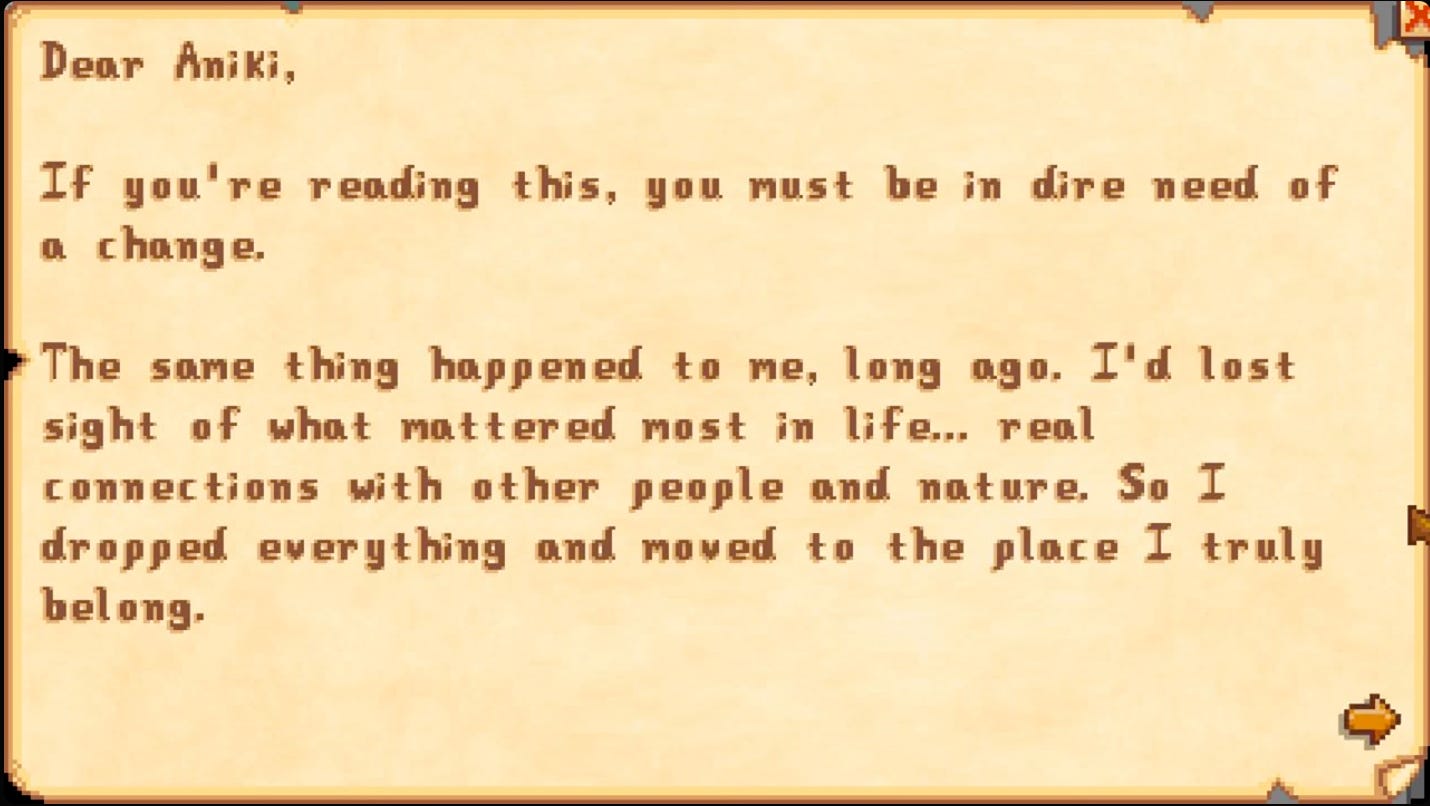
If you’re reading this and you’ve lost sight of what matters most in life—real connections with other people and nature—start with Stardew Valley. If you have already become a part of the Stardew Valley membership, I encourage you to find the real, true version of it. Read Berry to understand more deeply what Stardew is trying to teach. Then start doing it for real: day by day, season by season, year by year. Wander the streets, fields, parks, and woods where you live. Learn the names of things. Learn the names of people. Go to the local coffee shop or bar and talk to the people you’ve seen there more than once. Offer to help your neighbors and accept their help in return. It’s these small things that make us human. You don’t need to live in a different world—the world of Stardew Valley or Port William. Just start truly living in yours.
Further Reading
“A Native Hill” by Wendell Berry, available for free (if you create an account) on JSTOR
Berry’s “Window Poems”, also available on JSTOR
This profile on Berry in the New Yorker
“Hannah Coulter”, a great intro novel for Berry’s Port William
“The World Ending Fire”, a collection of Berry’s essays collected by and with a preface from Paul Kingsnorth
Eric Barone, the creator of Stardew Valley, in an early interview talking about his influences
- Paul Kingsnorth, preface to The World-Ending Fire, p. 10 ↩
- “Window Poem 6,” The Selected Poems of Wendell Berry, p. 39 ↩
- Hannah Coulter, p. 42 ↩
- “A Native Hill,” in The World-Ending Fire, pp. 28-29 ↩
- “A Native Hill,” in The World-Ending Fire, p. 8 ↩
- Paul Kingsnorth, preface to The World-Ending Fire, p. 10 ↩